Liu Chen
The Romance of the Three KingdomsLiu Chen, the son of Shu’s last ruler, stands against his father’s decision to surrender to Wei. His brief but decisive role turns the fall of Shu into a conflict between political submission and loyalty to the kingdom: unwilling to accept the end of his inheritance, he chooses death rather than live under the new authority.
Identity and Family
The account presents Liu Chen as the only one among his father’s seven sons with spirit and strength. His father, facing the prospect of defeat, is urged by Qiao Zhou to surrender to Wei rather than risk a further collapse and the suffering that might follow. The ruler remains troubled, but Qiao Zhou’s memorial supports surrender and helps him settle on that course.
Opposition to Surrender
Liu Chen responds with open defiance. He condemns Qiao Zhou as a coward for urging the ruler to do what no emperor had done before, and insists that Jiang Wei remains capable of fighting. He argues that Shu should hold on rather than yield. His father rebukes him as a shallow, warlike youth who would increase the bloodshed, and dismisses his appeal by asserting that Liu Chen does not understand Heaven’s will.
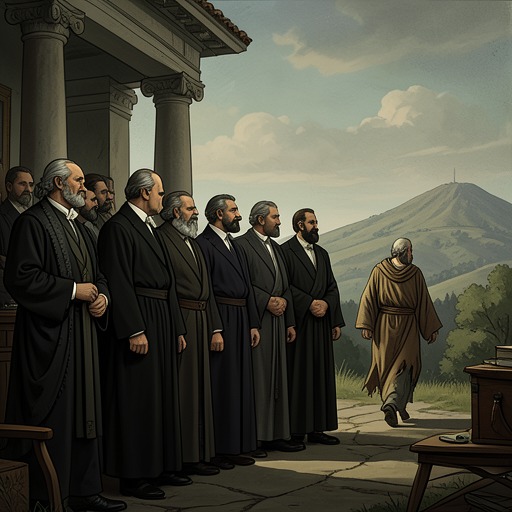
Liu Chen does not relent. He declares that he will not live to see his patrimony given away, but his father orders him out of the hall and has the surrender document prepared. Envoys then deliver the document and the seal of authority to Deng Ai’s camp. After they return, the ruler instructs Jiang Wei to surrender as well. The sequence leaves Liu Chen’s resistance isolated: the decision has been made, the formal submission carried out, and the remaining commander ordered to comply.
Final Choice
Unable to bear the humiliation of surrender, Liu Chen returns to his palace with his sword. His wife, Lady Cui, asks what has happened. When he explains his decision, she says she will share his fate and asks to die first. She frames their choice through the obligations of marriage: he will die for his father, and she for her husband. She then dies by striking her head against a pillar.
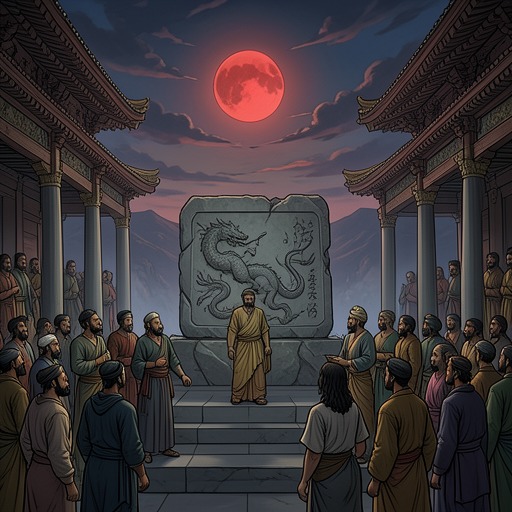
Liu Chen kills his three sons, takes his wife’s head, and goes to the temple of the late ruler, Xuande. There he kneels and weeps, offers the souls of his wife and sons, and takes his own life with his sword. His final act is therefore both familial and political: he brings his household into his refusal to outlive Shu’s surrender, and makes the temple of the former ruler the setting for that last declaration of allegiance.
Political and Narrative Significance
Liu Chen’s resistance recalls the story’s larger struggle over legitimate rule. Earlier, Kong Ming urged Xuande to claim authority in the name of the Han and the people; after Cao Pi took the throne and established Wei, Xuande was urged to continue the Han line by becoming emperor himself. At Shu’s end, however, its ruler accepts surrender while Liu Chen rejects the transfer of his inheritance. The contrast makes the fall more than a military change of power: it stages a final dispute over whether survival through submission or loyalty expressed through refusal should prevail.
The narrative grants Liu Chen no power to reverse the surrender. His argument fails, Jiang Wei is ordered to yield, and Shu’s political fate is already decided. What remains to him is a personal choice, carried out at the temple of Xuande and through the deaths of his family and himself. His story closes the kingdom’s collapse with an image of loyalty that cannot preserve the state, but refuses to accommodate its end.